Water plays a bigger role in business operations than many people realize. It’s easy to think of it as something that simply comes through a faucet, gets used, and disappears down a drain. In a commercial setting, though, water can affect equipment, cleaning routines, customer experiences, operating costs, and even the day-to-day rhythm of a workplace.
A restaurant uses water constantly. Hotels depend on it for hundreds of rooms. Offices may have kitchens, coffee stations, bathrooms, and cooling equipment. Manufacturing facilities can have entirely different requirements again.
So when water causes scale, sediment, unpleasant odors, or other problems, the answer usually isn’t as simple as putting a filter under the sink.
Commercial properties need a treatment strategy that fits how the building actually operates.
Every Business Has Different Water Demands
There isn’t a universal definition of “commercial water.”
A small office with twenty employees may use relatively little water compared with a hotel, healthcare facility, restaurant, apartment complex, or production site.
Usage patterns matter just as much.
Some businesses have heavy demand during specific hours. Others use water consistently throughout the day. A restaurant might experience a sharp rush during lunch and dinner, while a hotel can have unpredictable demand depending on occupancy.
Good commercial water solutions begin with understanding these patterns.
System capacity, flow rate, water pressure, available installation space, and treatment goals should all be considered before equipment is selected. A system that works beautifully in one building may be completely wrong for another.
Start With Water Testing
Before investing in treatment equipment, find out what’s actually in the water.
Testing can provide information about characteristics such as hardness, pH, iron, manganese, sediment, dissolved solids, and other factors depending on the analysis.
This matters because different problems require different technologies.
If hard water is causing scale, a softening strategy may help. If sediment is clogging equipment, filtration could be more appropriate. If taste and odor are the main complaints, another type of filtration may be useful.
Without testing, businesses can spend money solving a problem they don’t really have.
Hard Water Can Become an Operational Headache
Hard water tends to make itself known gradually.
Mineral deposits can accumulate in water heaters, boilers, dishwashers, coffee equipment, plumbing components, and other systems that regularly handle water.
In a commercial environment, even small efficiency losses can become expensive when equipment operates every day.
Commercial water softeners can be used in applications where hardness reduction is appropriate. By reducing the minerals responsible for hardness, softening can help limit scale formation in suitable systems.
However, sizing is important. A softener designed for a small building may struggle to keep up with a busy commercial property.
Filtration Has a Different Job
Water filters aren’t all designed to do the same thing.
Some are intended to remove sediment. Others use carbon to reduce certain tastes and odors. Specialized filtration systems can target specific characteristics identified through water testing.
For businesses, filter capacity and service intervals are particularly important.
A filter that needs constant replacement can become a nuisance, especially if the business depends on uninterrupted water service.
Commercial water filters should therefore be selected based not only on what they remove, but also on expected flow, usage volume, replacement requirements, and operating conditions.
Think About Where the Water Is Used
A commercial property rarely has just one water application.
There may be drinking-water stations, bathrooms, kitchens, laundry areas, boilers, ice machines, dishwashers, or production equipment.
Not every application necessarily needs the same treatment.
A point-of-use system may be appropriate for drinking water, while whole-building treatment may be more useful for hardness or sediment concerns affecting multiple fixtures.
Trying to treat everything in exactly the same way can create unnecessary expense.
Water Pressure Can Affect Performance
Commercial buildings often have complicated plumbing systems.
Water may need to travel considerable distances or serve multiple fixtures at once. Treatment equipment adds another component to that system, so pressure and flow need to be considered carefully.
A filter that performs well under light demand may become restrictive during peak usage if it isn’t correctly sized.
This is why commercial system design should account for both average and peak demand.
It’s better to plan for the busiest part of the day than to discover during a lunch rush that the treatment system can’t keep up.
Don’t Overlook Space and Access
Commercial equipment needs a practical installation location.
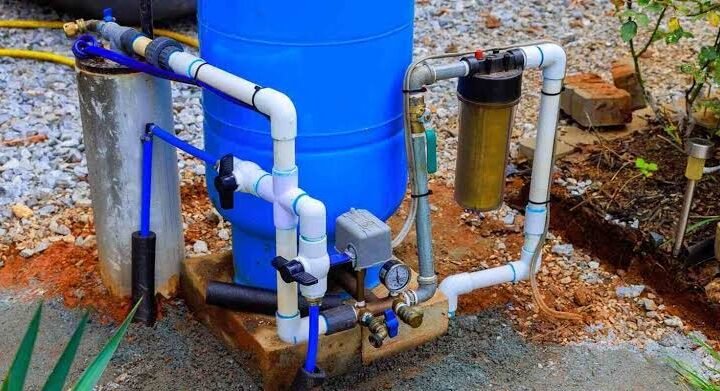
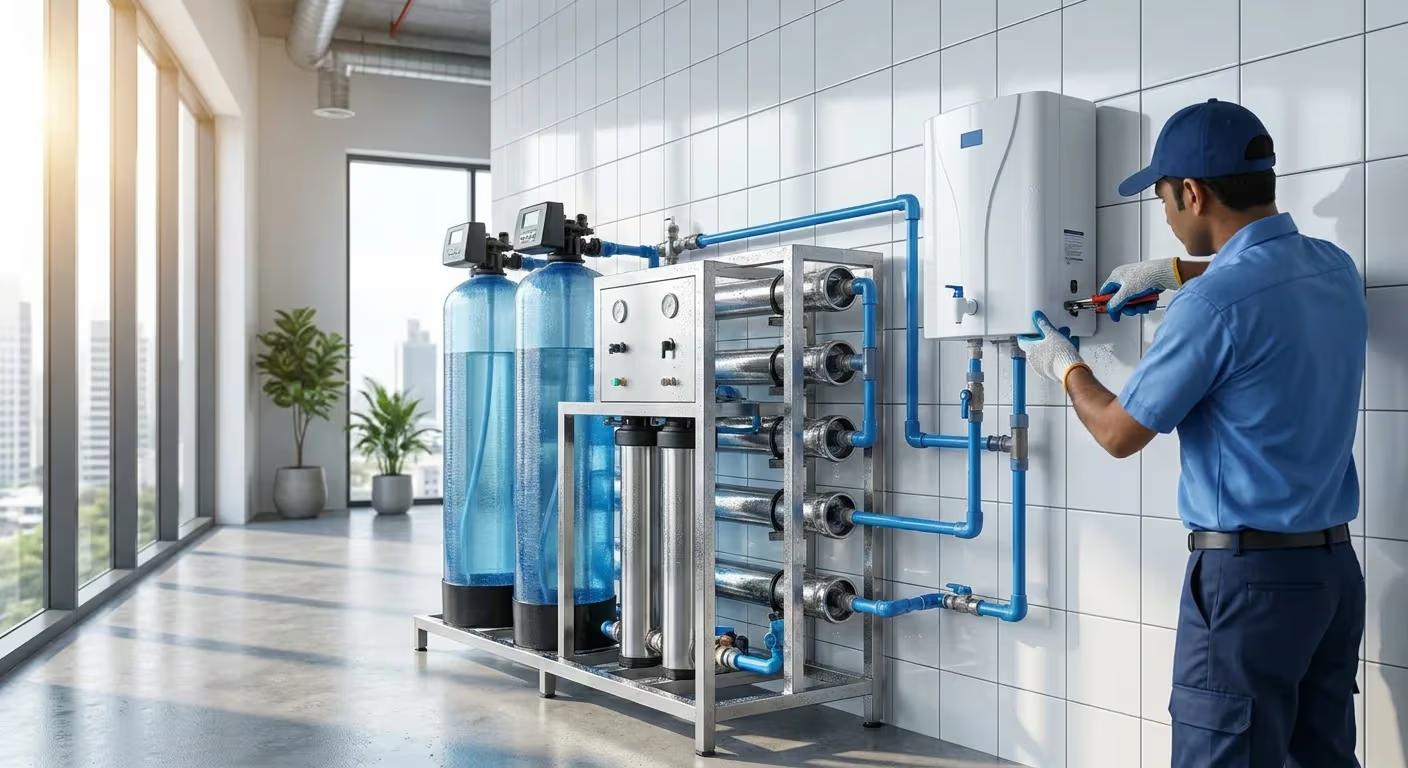
Tanks, filter housings, valves, pumps, and related components need sufficient clearance. Technicians also need room to inspect and service the equipment.
Installing a system in an inaccessible corner may seem convenient during construction, but it can make future maintenance unnecessarily difficult.
Think about access before installation.
Someone will eventually need to replace a filter, check a valve, clean a component, or troubleshoot an issue. Make sure they can actually reach it.
Maintenance Is Part of the Business Plan
Commercial water treatment shouldn’t be maintained only when something breaks.
Preventive maintenance can help identify problems before they interrupt operations.
Filter changes, inspections, softener servicing, membrane replacement, pressure checks, and sanitation procedures may all be part of a system’s maintenance requirements depending on the equipment.
Keeping service records is useful, especially for businesses with multiple systems.
A simple maintenance schedule can help facility managers know what needs attention and when. It also reduces the chance that an important service interval gets forgotten during a busy month.
Reliability Matters More in a Commercial Setting
At home, a water-treatment problem is annoying.
At a business, it can be disruptive.
A restaurant dealing with poor water quality may have trouble with food preparation or cleaning. A hotel could face complaints from guests. A manufacturing operation may have equipment or process concerns.
That doesn’t mean every commercial system needs excessive redundancy. It means the consequences of poor planning can be greater.
Treatment equipment should be selected with the business’s operating requirements in mind.
Consider Operating Costs, Not Just Purchase Price
A commercial treatment system is a long-term investment.
The initial equipment cost is only one part of the equation. Businesses should also consider filter replacement, salt consumption, electricity, water use, service requirements, and eventual component replacement.
A system with a lower upfront price may cost more to operate over several years.
On the other hand, an expensive system isn’t automatically more efficient.
Look at the total cost of ownership. Ask how often components need servicing, how readily replacement parts are available, and whether the system can be adjusted as water demand changes.
Professional Installation Can Prevent Problems
Commercial water treatment is not always a good candidate for improvisation.
Proper installation requires attention to plumbing connections, flow direction, pressure, drainage, electrical requirements where applicable, and local operating conditions.
A professional installer can also help verify that the equipment is sized and configured correctly.
Good installation isn’t just about getting the pipes connected. It’s about making sure the entire system works as intended.
Businesses Should Plan for Future Growth
A treatment system installed today may still be operating years from now.
But will the business look the same?
Maybe an office will add employees. A restaurant may expand its kitchen. A hotel could renovate additional rooms. Production demand might increase.
If water usage is likely to change, consider whether the treatment system has enough capacity or flexibility to accommodate future requirements.
Planning ahead can be much cheaper than replacing undersized equipment later.
Don’t Treat More Than Necessary
It’s tempting to build a highly complicated treatment system because more equipment can sound reassuring.
But unnecessary components increase maintenance and operating costs.
The better strategy is targeted treatment.
Identify the water-quality concern. Understand the business’s demand. Choose equipment that addresses the actual issue and can handle the expected workload.
Simple, when it works, is a very good thing.
Good Water Treatment Should Stay Out of the Way
The ideal commercial water system isn’t something employees think about every morning.
It should operate quietly in the background while the business focuses on its actual work.
That requires thoughtful planning, accurate water information, appropriate equipment, and consistent maintenance.
Whether the property needs softening, filtration, drinking-water treatment, or a combination of technologies, the right solution is the one that fits the building rather than forcing the building to adapt to the equipment.
Commercial water treatment isn’t really about buying a machine.
It’s about protecting an important part of the operation.
When the system is properly designed and cared for, water becomes what it should be in a busy workplace: dependable, predictable, and almost completely unremarkable — which, when you think about it, is exactly what you want.