Water problems rarely arrive with a dramatic announcement. More often, they sneak into everyday life.
A glass has a strange taste. The shower door develops spots again, even though you cleaned it yesterday. Laundry doesn’t feel quite as soft, or the faucet starts collecting a crusty ring around its base. You notice these things, shrug, and carry on. Then, eventually, you start wondering whether the water itself is responsible.
Sometimes it is.
But treating household water isn’t as simple as choosing the biggest filter or the most expensive equipment. Different problems require different approaches, and the same water treatment system won’t necessarily make sense for every home.
The smartest place to begin is with a little curiosity. What is happening? Where is it happening? And what does the water actually contain?
Those questions can prevent a lot of unnecessary spending.
Look for Patterns Around the House
Before buying treatment equipment, pay attention to the symptoms.
Does the issue happen at every faucet or only one? Does it appear in hot water, cold water, or both? Do you notice scale, particles, unusual odors, or changes in pressure?
These details can provide useful clues.
For homeowners dealing with problem water treatment in the treasure valley, understanding local conditions can be helpful, but the individual property still matters. Water source, plumbing age, household usage, and existing treatment equipment can all influence what you experience at the tap.
In other words, don’t assume that the solution installed in the house next door is automatically the right one for your home.
Hard Water Can Be a Persistent Nuisance
One of the most familiar household water concerns is hard water.
Hardness is primarily associated with calcium and magnesium. These minerals can leave deposits on fixtures and glassware, affect how soap behaves, and contribute to scale inside appliances that regularly heat water.
You may not notice the problem immediately. It can build gradually until cleaning the showerhead becomes a regular chore and the coffee maker needs descaling far more often than expected.
Hard water isn’t necessarily a sign that the water is unsafe. Often, the concern is practical: protecting fixtures, improving cleaning, and making everyday water use less frustrating.
Depending on the hardness level and household goals, a properly sized softener or conditioning system may be worth considering.
Sediment Is a Different Kind of Problem
Hardness isn’t the only issue homeowners encounter.
Sediment refers to particles that can be present in water. They may come from a private well, changes in the water source, plumbing conditions, or other factors.
You might notice sediment collecting in faucet aerators or see particles settle at the bottom of a container. In some cases, it can clog filters faster than expected.
A sediment filter can be useful when particle removal is the goal, but the right filter depends on particle size and concentration.
This is an important distinction because a system designed for sediment isn’t necessarily designed to address hardness, dissolved minerals, or every possible water-quality concern.
Start With Testing Instead of Guesswork
Clear water isn’t necessarily a complete picture of water quality.
Some characteristics are invisible, while harmless air bubbles can occasionally make water look cloudy. If you’re concerned about a persistent issue, testing can provide information that your eyes and taste buds simply can’t.
Depending on the situation, water analysis may examine hardness, pH, iron, sediment, and other characteristics.
Testing is especially valuable before investing in expensive treatment equipment. You want to know what you’re treating.
There is little benefit in buying a system that solves a problem you don’t have.
Your Water Source Matters
Municipal water and private well water can have very different characteristics.
Public water supplies are generally treated before reaching the property. Private well owners, meanwhile, are responsible for monitoring their own water and responding to changes.
Well water may naturally contain minerals, iron, sediment, or other substances depending on local geology.
If you’re on a well, regular testing can help you understand whether conditions are changing.
Even municipal water users can benefit from understanding their supply, particularly if they notice a sudden change in taste, odor, or appearance.
Don’t Blame the Treatment System Too Quickly
Sometimes a water complaint is actually a plumbing issue.
A faucet aerator can collect debris. An older fixture can affect taste. A water heater can create problems that don’t appear in cold water.
If strange-tasting water occurs only at one faucet, start there.
Likewise, if an odor appears only when hot water is running, inspect the water heater before assuming the entire home’s water supply needs treatment.
Good troubleshooting isn’t glamorous, but it can save you from making an expensive mistake.
Flow Rate Should Be Part of the Conversation
Treatment equipment has to handle the amount of water your household actually uses.
A system that’s perfectly adequate for a couple may not be appropriate for a large family with multiple bathrooms and several water-using appliances.
Peak demand matters.
Picture a busy morning: two showers are running, someone is washing dishes, and the washing machine starts filling. If the system is undersized or unnecessarily restrictive, pressure problems may become noticeable.
When selecting equipment, consider household size, number of fixtures, typical usage, and peak flow requirements.
The largest system isn’t automatically the strongest choice. Correct sizing is what counts.
Installation Should Be Planned, Not Improvised
Where equipment is installed can make a big difference later.
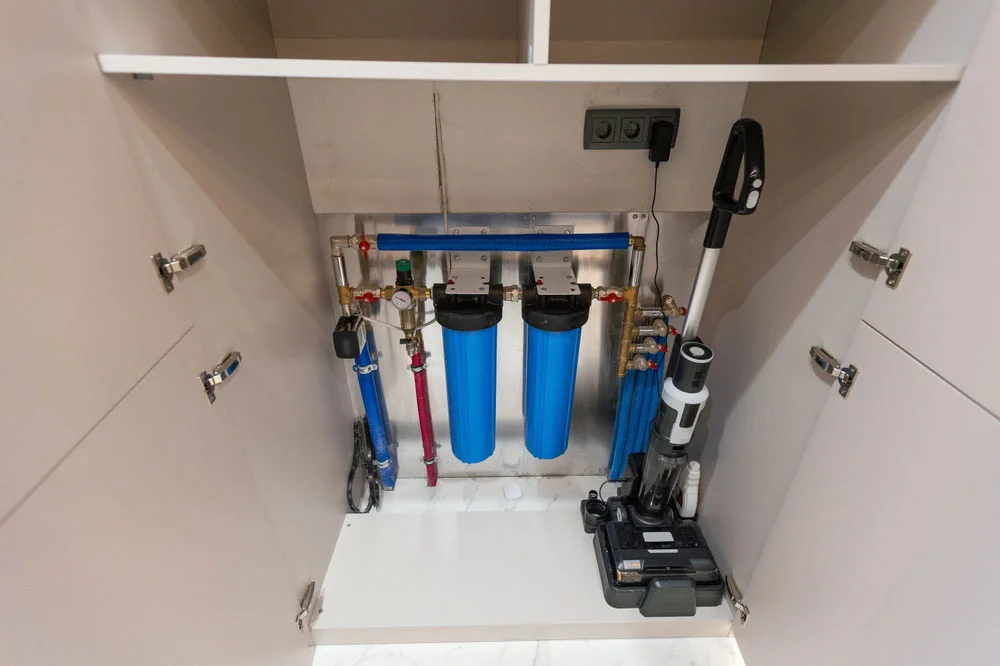
There should be enough space for connections, drainage, controls, and service access. Filters should be easy to reach, and important valves shouldn’t be buried behind storage.
A tidy installation is nice, but accessibility is more important.
Think ahead to the first filter replacement. If it requires crawling through a cramped space with a flashlight between your teeth, you’ll quickly understand why planning matters.
Maintenance Keeps Treatment Effective
Water treatment systems don’t work indefinitely without attention.
Filters need replacement. Some equipment needs cleaning, sanitation, regeneration, or inspection. Mechanical parts can eventually wear out.
Keeping a basic service schedule is one of the easiest things you can do.
Write down when filters were changed. Keep track of service visits. Pay attention to pressure, taste, odor, and water appearance.
If something changes, investigate early.
A clogged filter may be simple to replace. A neglected system can create much bigger problems.
Think About the Cost Over Time
The purchase price is only the beginning.
Replacement filters, consumables, electricity, maintenance, and repairs can all add to the long-term cost of ownership.
Before choosing equipment, ask what routine service looks like. Find out which components need regular replacement and how easy they are to obtain.
Sometimes the system with the lowest upfront price isn’t the least expensive option over several years.
Value is about the whole ownership experience.
Avoid the “More Is Better” Trap
It can be tempting to add several treatment stages simply because they sound beneficial.
But every component should have a purpose.
If testing identifies hardness, address hardness. If sediment is the concern, use appropriate particle filtration. If taste and odor are the priority, consider technology designed for those characteristics.
A complicated system isn’t automatically a better system.
In fact, unnecessary equipment can mean more maintenance, more replacement parts, and more opportunities for something to go wrong.
Simple, when properly designed, can be remarkably effective.
Technology Can Help, But It Isn’t Everything
Modern water systems may include digital controls, automatic alerts, and monitoring features.
These tools can be useful, especially when they help homeowners track maintenance or notice unusual water use. But technology shouldn’t distract from the basic question of whether the treatment itself is appropriate.
A smart control panel can’t compensate for the wrong filter.
Start with the fundamentals, then use technology where it genuinely adds value.
A Better Water System Starts With Better Information
Water treatment doesn’t need to feel overwhelming.
Start by noticing what’s happening around your home. Consider the water source. Test when appropriate. Think about household demand and plumbing. Then choose treatment that directly addresses the conditions you’ve identified.
That approach may take a little more thought at the beginning, but it can save considerable frustration later.
The goal isn’t to own the most complicated water system available. It’s to have a system that fits your home and quietly does what it’s supposed to do.
When the water tastes right, fixtures stay cleaner, pressure remains dependable, and equipment is easy to maintain, you probably won’t think about your treatment system very often.
And honestly, that’s a pretty good sign that you chose well.