Water treatment is often approached one faucet at a time. A filter under the kitchen sink. A pitcher in the refrigerator. Maybe a small cartridge attached to the shower. These solutions can be useful, but they only address water at a particular point.
If the concern affects the entire property, treating water as it enters the home can be a more practical approach.
A whole-house system isn’t necessarily about making water “perfect.” It’s about addressing known water-quality concerns before that water travels through the home’s plumbing, appliances, showers, and faucets. The right setup can make everyday water more pleasant while helping manage issues that otherwise show up throughout the house.
Still, there’s no universal system that works for every property. The best choice depends heavily on the water source and what testing reveals.
Start With the Water Source
The first question should be simple: where does your water come from?
Homes connected to a municipal supply receive water that has already undergone treatment. However, that doesn’t mean the water arrives at every household with identical characteristics. Distribution systems, plumbing materials, and local conditions can influence what comes out of a tap.
Private wells are different. Groundwater chemistry varies from one area to another, and homeowners are responsible for monitoring their own wells.
Understanding the source gives you a starting point. Testing then fills in the details.
Why Whole-House Filtration Can Be Useful
A whole-home filtration system treats water before it travels through much of the home’s plumbing. Depending on the technology used, filtration can target sediment, chlorine taste and odor, certain chemicals, iron, or other specific water-quality concerns.
The benefit is convenience. Instead of treating only the water coming from one faucet, the system can address the selected issue across multiple fixtures.
Imagine taking a shower and noticing an unusual odor, then filling the washing machine with the same water, then using it to rinse dishes. If the problem affects the entire home, a point-of-use filter may not be enough.
But whole-house filtration isn’t automatically better. If the concern is limited to drinking water, a smaller point-of-use system might be more economical.
Municipal Water Isn’t Automatically Identical Everywhere
Municipal water providers disinfect and monitor their supplies, but the water still has to travel through miles of infrastructure before reaching individual buildings.
Disinfectants are intentionally used to control microorganisms in public water systems. Some homeowners notice the taste or smell associated with these chemicals more than others.
For people concerned about city water treatment chemicals, it’s useful to distinguish between substances intentionally added during water treatment and contaminants that may enter water from other sources.
Activated carbon filtration is commonly used to reduce chlorine taste and odor. However, not every carbon filter performs the same way, and contact time, flow rate, filter capacity, and cartridge condition can all affect performance.
The answer isn’t always “remove everything.” Sometimes it’s simply making the water more comfortable to use.
Well Water Tells a Different Story
Well water can be perfectly usable, but it deserves regular attention because groundwater chemistry isn’t fixed.
One common concern is sediment. Sand, silt, clay, rust particles, and other suspended material can enter well systems, especially when the well or surrounding groundwater conditions change.
Well water sediment can cause cloudy water, clog faucet aerators, shorten the life of downstream filters, and create problems for appliances.
A properly selected sediment filter can help, but the filter needs to be sized according to the amount and type of material present. If a filter clogs repeatedly, simply installing another identical cartridge may not solve the underlying problem.
The source of the sediment should be investigated.
Filtration Isn’t the Same as Softening
This distinction causes plenty of confusion.
A filter is designed to capture or reduce particular substances. A water softener, meanwhile, is primarily intended to reduce hardness caused by calcium and magnesium.
If your faucets have white mineral deposits, soap doesn’t lather well, and water heaters are developing scale, hardness may be the main concern.
A sediment filter won’t solve hardness. Likewise, a water softener isn’t designed to remove every contaminant.
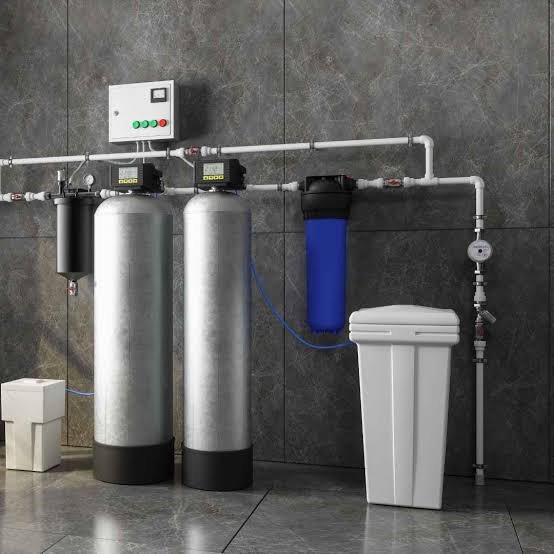
Some properties need multiple treatment stages. That’s not necessarily excessive. It’s simply a reflection of the chemistry of the incoming water.
Where Should the Equipment Go?
Whole-house treatment equipment is often installed near the point where water enters the property.
The location needs enough space for installation, maintenance, filter replacement, and future repairs. Drainage requirements and electrical access may also matter depending on the system.
It’s worth thinking ahead.
A system that fits neatly into a utility room today may become frustrating if there’s no room to remove a filter housing or access a valve later.
Accessibility is one of those boring details that becomes very important the first time something needs servicing.
Flow Rate Matters
A treatment system needs to keep up with the home’s water demand.
Picture a busy morning: one person is showering, someone else is brushing their teeth, the washing machine is running, and a toilet flushes. If the treatment system is too restrictive or undersized, water pressure and flow can suffer.
Manufacturers often provide recommended flow rates and operating conditions. These specifications shouldn’t be ignored simply because a particular model looks attractive.
Proper sizing is about real household use, not just the number of people living under the roof.
Don’t Forget Pretreatment
Some water conditions can shorten the life or reduce the performance of downstream treatment equipment.
For example, heavy sediment may need to be removed before a finer filtration stage. Hardness or iron may interfere with certain processes. Depending on the treatment technology, pretreatment can be an important part of the design.
This is another reason water testing should come before equipment selection.
You want the system to work as a coordinated process rather than a collection of unrelated filters.
Maintenance Keeps Treatment Effective
Every filter eventually reaches its capacity.
Sediment cartridges collect material. Carbon media eventually becomes exhausted. Softener resin requires regeneration. Other specialized treatment media have their own service schedules.
A whole-house system that’s ignored for years can become less effective and may eventually restrict water flow.
Keep track of filter replacement dates. Pay attention to changes in pressure and water appearance. If the system has a monitoring feature, use it.
Maintenance isn’t glamorous, but it’s what keeps the equipment doing the job you paid for.
Think About What You Actually Want to Improve
Before buying a whole-house system, write down the problems you’re trying to solve.
Is the water cloudy? Does it smell like chlorine? Are there orange stains? Is hardness leaving deposits everywhere? Does the water taste unusual?
Then test the water and compare the results with your observations.
This approach is far more reliable than buying a system because the packaging promises “cleaner water.”
A Whole-House System Should Solve a Real Problem
There is something satisfying about treating water at the point where it enters your home. One well-designed system can address a problem across many fixtures instead of relying on several small devices scattered around the house.
But bigger isn’t always better.
The smartest setup is one matched to the source water, household demand, treatment goals, and budget. Sometimes that’s a multi-stage whole-house system. Sometimes it’s a simple sediment filter. Sometimes the best answer is a point-of-use drinking-water system.
The key is knowing the difference.
Water doesn’t need to be mysterious. Test it, understand what you’re seeing, and choose treatment based on facts. Once you do, the right system usually becomes much easier to identify—and everyday water becomes one less thing you have to worry about.