The first time I sat in on a startup pitch meeting in Bengaluru, the founder kept saying “we’re pre-Series A” like everyone in the room should just know what that meant. Half the room nodded. The other half, including me at the time, had no clue. Understanding startup funding stages isn’t optional if you’re raising money — investors expect you to speak their language.
Let’s break it down properly, stage by stage.
What Are Startup Funding Stages, Exactly?
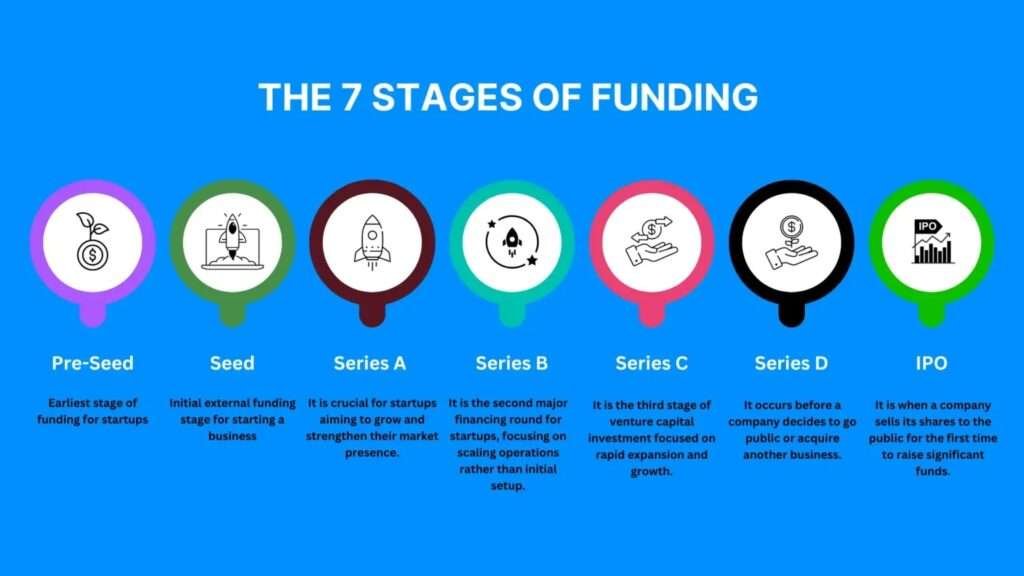
Startup funding stages are the different rounds of investment a company raises as it grows — starting from an idea with no revenue, all the way to a company with proven, scalable growth. Each stage brings a different amount of money and a different level of investor scrutiny.
Pre-Seed: The “Just an Idea” Stage
This is where founders raise money from friends, family, or their own savings — usually ₹10 lakh to ₹1 crore in the Indian context. There’s often no product yet, just a prototype or a strong pitch.
Angel investors sometimes step in here too, betting on the founder more than the business itself.
Seed Stage: Building the First Version
By seed stage, you usually have an MVP (minimum viable product) and maybe some early users. Funding here can range from roughly ₹1 crore to ₹8 crore, often from seed funds or angel networks.
At the seed stage, investors are mainly betting on the team and early traction, not on profits — profitability isn’t expected yet.
Series A: Proving the Business Works
This is where things get serious. You need actual data: user growth, revenue trends, retention numbers. Series A rounds in India typically range from $2 million to $15 million.
Investors at this stage ask hard questions like:
- What’s your customer acquisition cost?
- How fast is your revenue actually growing month over month?
- Can this scale beyond your current city or niche?
Series B: Scaling What Already Works
By Series B, the business model is validated. The money here goes into scaling — hiring, expanding to new markets, building out infrastructure. Rounds often range from $15 million to $50 million or more depending on the sector.
[link to related guide about business model validation here]
Series C and Beyond: Aggressive Growth or Acquisition Prep
Series C funding usually supports major expansion — new countries, new product lines, or acquiring smaller competitors. Some companies also raise Series C to prepare for an IPO down the line. At this point, the company is often valued in the hundreds of millions or billions.
How Long Does Each Stage Usually Take?
There’s no fixed timeline, but here’s a rough pattern many Indian startups follow:
- Pre-seed to seed: 6-12 months
- Seed to Series A: 12-18 months
- Series A to Series B: 18-24 months
- Series B to Series C: varies widely, often 2+ years
I’ll be honest — these timelines get thrown off constantly by market conditions. 2023 and 2024 saw much longer gaps between rounds than 2021 did.
What Investors Look for at Each Stage
Broadly speaking, the focus shifts as you move up:
- Pre-seed/Seed: team, idea, early signal
- Series A: product-market fit, growth metrics
- Series B: scalability, repeatable growth playbook
- Series C+: market dominance, path to profitability or exit
[link to related guide about pitching investors here]
FAQ
Do all startups need to go through every funding stage? No. Plenty of profitable startups skip rounds entirely by staying bootstrapped, or they raise once and never again.
What’s the difference between an angel investor and a VC? Angels usually invest their own money, often at earlier stages. VCs manage pooled funds and typically enter from seed stage onward with larger checks.
How much equity do founders usually give up per round? It varies, but 15-25% per round is a common (not universal) range, especially in early stages.
Can a startup raise Series A without revenue? It’s rare but possible, especially in deep-tech or category-defining products where growth metrics matter more than revenue right now.
What happens if a startup can’t raise the next round? Some pivot, some get acquired, some slow down growth to reach profitability (called “extending the runway”), and unfortunately, some shut down.
Conclusion
Knowing your startup funding stages isn’t just trivia — it shapes how you pitch, what metrics you track, and when you should even start fundraising conversations. Don’t chase the next round just because it sounds impressive. Raise when you actually need the capital to hit your next real milestone, not before.
[Suggested image alt text: “startup founders pitching to investors in a meeting room”] [Suggested image alt text: “funding stages growth chart from seed to series C”]